Disclosure: This article may contain affiliate links. We earn a commission at no extra cost to you if you purchase through our links. We only recommend tools we genuinely believe in.
I once delivered a project, sent the invoice, and then did not look at it again for six weeks. The work was done, the client was happy, and the money was sitting in their accounts payable queue, waiting for someone to ask for it. Nobody asked, because the someone was me, and I kept finding a reason to wait one more day: the client was busy, the timing was awkward, I did not want to sound pushy about money when the relationship was going well. By the time I finally sent a short note, the invoice was 45 days overdue, and the client paid it the same afternoon, with an apology, because they had simply forgotten. The delay was not their fault. It was mine, for running collections on memory and courage instead of a schedule.
This post is the sequel to How I Price a Project With AI (and Stop Undercharging for the Work). A good price means nothing if the money arrives two months late, and the pricing worksheet from that post is where the payment terms in this one start. It also builds on How I Run a Monthly Retainer Review With AI (and Keep Clients Renewing), because the retainer review is where an overdue invoice stops being a task and starts being a pattern you can see.
This is a playbook, not a results report. The figures below are planning templates to tune after your first few invoices, not measured outcomes. Your terms and your clients will differ, and that is fine. The system is the point, not the numbers in it.
The Problem: Collections Run on Memory and Mood
Most late invoices are not disputes. They are drift. Four habits cause almost all of it:
- No schedule, only intentions. You plan to follow up "this week," and this week slides into next week, because no date is written down and no reminder fires. An invoice with no follow-up date is an invoice you have decided to forget.
- The email is written from scratch, every time. Each reminder costs a decision: what tone, how firm, what to say. Decisions cost energy, and energy runs out, so the email never gets sent. A blank page is the most expensive part of collections.
- The tone escalates too fast, or not at all. The first nudge sounds like a threat, or the fourth nudge sounds like the first. Without a written ladder, every message is a guess at how firm you should be, and the guess is usually wrong in one direction or the other.
- The terms were never set. The invoice says "due on receipt" or nothing at all, and the client reads that as "whenever." Payment terms agreed after the work is a negotiation you have already lost, because the leverage was the work, and the work is done.
The fix is not being tougher. The fix is a schedule: four touches, written in advance, fired on dates, with the tone rising one step at a time. A client who gets a polite, on-time reminder does not feel chased. A client who gets nothing for six weeks and then a tense email feels ambushed. The schedule protects the relationship, not just the cash flow.
The System in One Pass
The stack is deliberately boring, and it reuses tools you already have. No new platform is required to start, and no message goes to a client without you reading it first.
| Stage | Tool | What happens |
|---|---|---|
| Terms | The quote and the invoice, plus the pricing worksheet | Payment terms are agreed before the work starts: due date, late fee, and what happens at 30 days |
| Track | A simple spreadsheet, or your invoicing tool | Every invoice gets a row: client, amount, due date, status, and next touch date |
| Draft | Claude or ChatGPT, with your tone and three past emails attached | Four reminder templates, written once, in your voice, at four levels of firmness |
| Send | Email, from you, on the scheduled date | You read the draft, adjust one line if needed, and send it yourself |
| Review | The monthly retainer review | Overdue invoices get one line each, and repeat offenders get a terms conversation |
Notice what automation does not do in this table: it does not decide when to escalate, it does not choose the tone for a specific client, and it does not send anything on its own. It drafts the words and tracks the dates. You decide, and you send, in your own words.
The Four-Touch Schedule
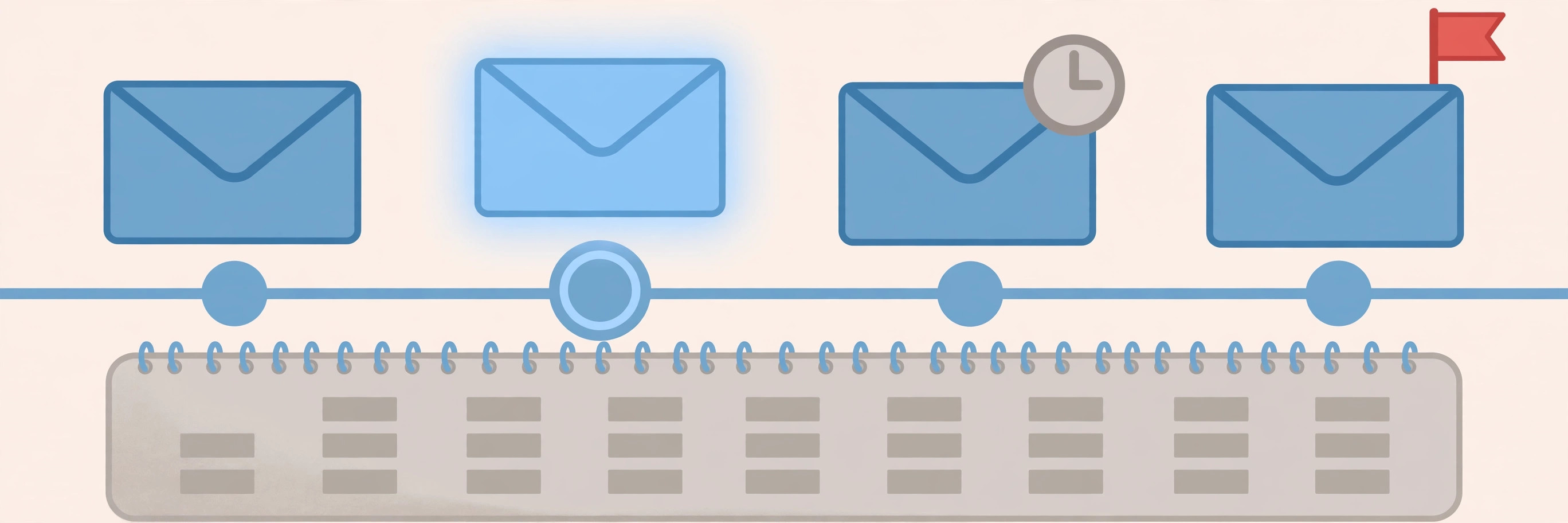
Every invoice gets the same four touches, on the same schedule, no matter how friendly the client is. Consistency is what makes it feel professional instead of personal.
| Touch | When | Tone | What it does |
|---|---|---|---|
| Touch 1: the nudge | 3 days before the due date | Friendly, helpful | Reminds the client the invoice is coming due, attaches the invoice again, and asks if anything is missing |
| Touch 2: the reminder | The due date, or 1 day after | Polite, matter of fact | Notes the invoice is now due, restates the amount and the payment link, and asks for a payment date |
| Touch 3: the check-in | 7 days overdue | Direct, curious | Asks whether something is wrong on their side, an approval, a process, a question, and offers a short call to clear it |
| Touch 4: the firm notice | 14 days overdue | Firm, specific | States the amount, the days overdue, the late fee if your terms include one, and the date you will pause work |
The first touch is the one people skip, and it is the one that matters most. An invoice that arrives with a friendly heads-up three days early gets paid on time far more often than one that arrives in silence, because the reminder lands while the invoice is still on top of the pile, not after it has sunk. Touch 3 is the diagnostic: most genuinely stuck invoices surface here, a missing approver, a new finance process, a question nobody asked. Touch 4 is the boundary, and it should be rare, because a system that works means most invoices never reach it.
Three Templates to Steal
Write these once, with AI drafting from your voice, then reuse them. The bracketed parts are the only lines you change per client.
Touch 1, the nudge. "Hi [name], a quick heads-up that invoice [number] for [amount] is due on [date]. I have attached it again here, in case it got buried. If anything is missing on your side, or you need a different format for your finance team, just say the word. Thanks, [your name]."
Touch 2, the reminder. "Hi [name], invoice [number] for [amount] was due [date]. Here is the payment link again: [link]. Could you let me know when it is scheduled, so I can mark it down on my side? Thanks, [your name]."
Touch 3, the check-in. "Hi [name], I wanted to check in on invoice [number], [amount], now [7] days past its due date. Usually when this happens there is something stuck on your side, an approval or a process change. Is there anything I can do to help clear it? Happy to jump on a short call if that is easier. Thanks, [your name]."
Touch 4, the firm notice. "Hi [name], invoice [number] for [amount] is now [14] days overdue. Per our terms, a [late fee, if any] applies from [date], and I will need to pause [the work] from [date] until the balance is settled. I would much rather keep things moving, so please let me know today when payment is going out. Thanks, [your name]."
Draft these with AI if you like. Give the model three emails you have actually sent, in your own voice, and ask it to write the four touches to match. It is good at that. What it cannot do is decide whether a specific client needs the firm notice or one more friendly call. That is your line, and it is the line that keeps the relationship intact.
The Terms That Stop the Problem Before It Starts
The schedule fixes late invoices. The terms prevent them. Set these on the quote, before the work begins, when your leverage is the work itself.
| Term | What to set | Example, as a planning figure |
|---|---|---|
| Due date | A number of days, written on the invoice and the quote | Net 14 for project work, net 7 for small one-off jobs |
| Deposit | A share of the fee, paid before work starts | 50 percent upfront on a first project with a new client |
| Late fee | A percentage per month, stated in writing, applied consistently | 1.5 percent per month after 14 days overdue, as a planning figure |
| Pause clause | What stops, and when, if payment is late | Work pauses at 14 days overdue, until the balance is settled |
| Payment method | One link, one method, no friction | A payment link on the invoice itself, so paying takes one click |
The deposit is the line people skip, and it is the line that matters most. A client who has paid half upfront has already decided you are worth paying, and the second half is a continuation, not a new decision. A late fee is not about the money, which is usually small. It is about the signal: the due date is real, and the contract says so. The pause clause is the boundary, and it only works if you use it once, calmly, and mean it.
What Breaks, and the Guardrail for Each
| Failure | Warning sign | Guardrail |
|---|---|---|
| The follow-up depends on memory | You realize an invoice is overdue only when you check the bank | Every invoice gets a next touch date the day it is sent, written in the tracker |
| Every reminder is written from scratch | The email sits unsent for a week because the blank page wins | The four templates exist before the first invoice goes out, in your voice |
| The tone jumps from silent to angry | The client is surprised, and the relationship takes the hit | The ladder rises one step at a time, and touch 1 goes out before the due date |
| The terms were never agreed | The client treats the due date as a suggestion | Terms go on the quote, before work starts, and the invoice repeats them |
| Work continues while payment is late | You are funding the client's delay with your own time | The pause clause is written down, and you use it once, calmly, at the date you set |
| Repeat offenders get the same terms | The same client is late three months in a row, and nothing changes | The retainer review flags the pattern, and the terms change: deposit up, or prepayment |
Rule: an invoice with no next touch date is an invoice you have decided to forget. Write the date the day you send it, and let the schedule do the asking.
Lessons at the End
- Late invoices are drift, not disputes. A schedule beats a confrontation, every time, because most clients simply forgot.
- Touch 1 goes out before the due date. The friendly heads-up is the cheapest payment you will ever collect.
- Four touches, one step at a time. Friendly, polite, direct, firm. Never jump the ladder, and never skip the first rung.
- Templates kill the blank page. The reminder that costs no decision is the reminder that actually gets sent.
- Terms are set on the quote, not on the overdue notice. The due date, the deposit, the late fee, and the pause clause belong in the agreement, before the work starts.
- AI drafts the words and tracks the dates. You decide and you send. It cannot tell whether a client needs one more friendly call or the firm notice. That judgment is the job.
If you build only one thing from this post, build the tracker and the first template: a row per invoice with a next touch date, and a friendly nudge that goes out three days before the due date. It takes about an hour to set up, as a planning figure. It does not make clients pay faster by being tougher. It makes them pay on time by asking on time, in writing, before the invoice has a chance to sink.