Disclosure: This article may contain affiliate links. We earn a commission at no extra cost to you if you purchase through our links. We only recommend tools we genuinely believe in.
In March I wrote AI Meta Ads Creative Testing Workflow: How I Find Winning Ads Faster. The core idea still holds: test the creative, not your patience. What has changed since then is how much of the grunt work AI can now handle, and how easy it has become to test badly at a much larger scale.
That is the real problem with AI creative testing in 2026. It is not that the tools are weak. It is that they make it effortless to launch 40 variations of the same unclear idea, watch the spend pile up, and learn nothing you can repeat. Speed without structure is just a faster way to burn budget.
So this is the updated workflow I use now: one angle per test, a small set of variations, clear kill and scale rules decided before launch, and AI doing the volume work while a human makes every judgment call that matters. No lab test, no invented win rate, just a playbook you can run on your next campaign.
It builds on the March workflow and on How to Use AI to Optimize Your Meta Ads: Complete 2026 Guide. If you read those first, this post is the testing layer that sits inside the optimization system.
The Problem With Most Creative Tests
Most creative tests fail before a single dollar is spent, because they test too many things at once. A new hook, a new image, a new audience, and a new offer land in the same ad, and when it works (or does not), nobody knows which change caused it.
The second failure is the opposite: one ad, one variation, launched with hope instead of a hypothesis. If it flops, the team concludes "Meta does not work for us" instead of "that angle did not work for that audience."
A useful test has three properties, and I check all three before I build anything:
- One variable changes at a time, or at least one angle is isolated per test cell
- The winner is defined before launch, in a metric and a threshold
- The loser gets killed on a schedule, not on a feeling
AI does not fix a test that breaks those rules. It just produces more versions of the broken test, faster.
The Stack
I keep the stack deliberately small. Every tool below has one job, and if a tool starts doing three jobs badly, it gets replaced.
| Job | Tool I use | What it actually does |
|---|---|---|
| Ad platform | Meta Ads Manager | Delivery, targeting, budget, and the results I judge against |
| Hook and script drafting | ChatGPT or Claude | First drafts of hooks, angles, and short video scripts |
| Image and video variations | Your creative tool of choice, plus AI image and video generation | Visual variations from one approved concept, not new concepts every time |
| Captions and ad copy variants | ChatGPT or Claude | Copy variations matched to each hook, reviewed before launch |
| Tracking and reporting | Meta Ads Manager plus a simple spreadsheet | One row per variation, one decision per row, no dashboard sprawl |
| Iteration notes | A shared doc or Notion page | What we tested, what won, what we killed, and why |
Nothing here is exotic, and that is the point. The workflow is the advantage, not the tool list. Swap any row for your equivalent and the system still works, as long as the roles stay separate.
Step 1: Write the Brief Before You Generate Anything
AI generation comes second. The brief comes first, and it fits on one page:
- Angle: the single idea the ad is selling, in one sentence. Example: "This tool saves media buyers the weekly reporting hour."
- Audience: who this angle is for, in plain words, not just a targeting preset.
- Offer: what happens when someone clicks, and what the landing page promises.
- Format: video, static image, or carousel, chosen for the angle, not for novelty.
- Hypothesis: what you expect to learn. Example: "A problem-first hook will beat a feature-first hook for cold traffic."
If you cannot write the angle in one sentence, you do not have a test yet. You have a brainstorm, and AI will happily turn it into 30 ads that all say slightly different unclear things.
Step 2: Generate Variations, Then Edit Like a Human
This is where AI earns its keep, and where it needs supervision. I ask for variations inside a tight frame, not open-ended ideas:
- 5 hook variations for the same angle, each under 12 words
- 3 opening lines for the same short video script
- 2 caption lengths for the same hook: one short, one with a proof point
- Visual variations of one concept: different crop, different first frame, different on-screen text
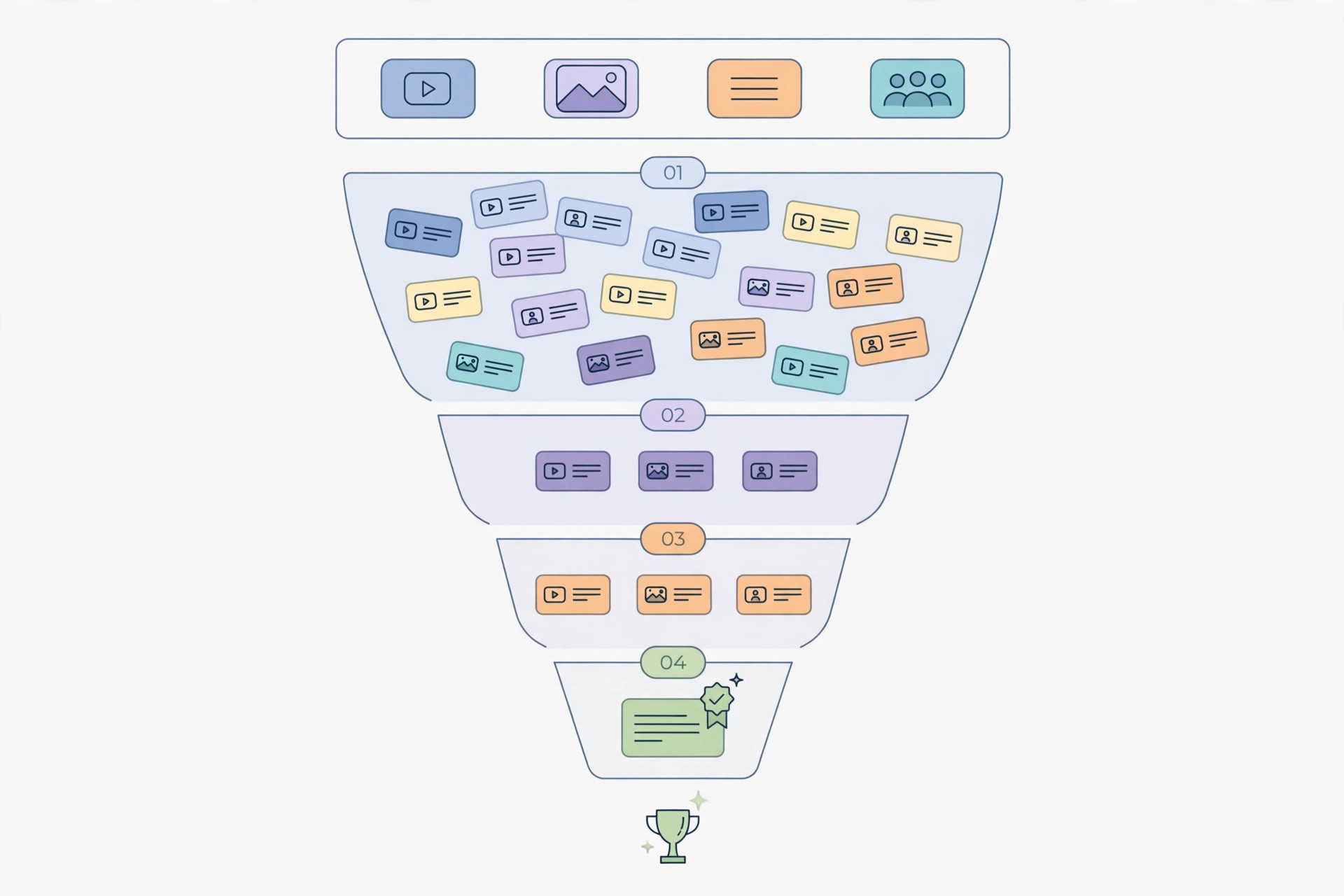
Then I cut ruthlessly. A typical round keeps 3 to 5 variations per angle. Anything that changes the angle, the promise, or the audience gets cut or saved for a separate test, because it would break the isolation rule from Step 1.
Two editing rules I never skip:
- Read every AI draft out loud. If it sounds like an ad, rewrite it until it sounds like a person explaining something useful.
- Check every claim against the landing page. If the ad promises something the page does not deliver, the click is wasted no matter how good the creative looks.
Step 3: Build the Test Matrix, Not a Pile of Ads
A test matrix is a small table that says exactly what is being tested and what counts as a win. Here is the shape I use for one angle:
| Test cell | What changes | What stays the same | Primary metric | Decision rule |
|---|---|---|---|---|
| Hook A, video | Hook only | Audience, offer, landing page, budget split | Cost per result, then click-through rate | Scale if it beats the control by a clear margin after the minimum spend, kill if it trails after the same spend |
| Hook B, video | Hook only | Same as above | Same as above | Same rule, judged separately |
| Hook C, static | Hook and format | Audience, offer, landing page | Same as above | Judged as a format test, not mixed into the hook ranking |
| Control, current best ad | Nothing | Everything | Same as above | The bar every variation must beat |
That last row matters most. A test without a control is a beauty contest. A test with a control is a decision.
On budget, I use planning figures, not promises. A typical starting test I plan for is 3 to 5 variations per angle, with a per-variation test budget set in advance, and a minimum spend threshold decided before launch so that no ad is killed after a handful of impressions. The exact numbers depend on your cost per result and your total budget, so set them from your own last 30 days of data, not from a blog post, including this one.
Step 4: Launch With Kill and Scale Rules Already Written
This is the step most teams skip, and it is the step that saves the most money. Before launch, write down:
- Minimum spend per variation: the point before which no decision is made, whatever the early numbers look like.
- Kill rule: the threshold at which a variation is paused, for example a cost per result well above the control after the minimum spend, with no improving trend.
- Scale rule: the threshold at which a variation gets more budget, for example beating the control on cost per result while holding the secondary metric steady.
- Review time: a fixed check-in, usually daily during a test, not a constant refresh habit.
Writing the rules down does two things. It stops the 9 a.m. panic pause, where a good ad gets killed because its first morning looked slow. And it stops the zombie ad, the one everyone knows is losing but nobody pauses because nobody owns the decision.
Step 5: Read the Results in Order
When the test finishes, read the metrics in this order, and do not skip ahead:
1. Primary metric first. For most direct response campaigns, that is cost per result. If a variation is cheaper on the primary metric, it leads, full stop.
2. Secondary metric second. Click-through rate, landing page conversion rate, or video watch time, depending on the format. This tells you why the winner won, or whether a cheap click is hiding a weak landing page.
3. Audience check third. Did the winner win across the audience, or only in one segment? A winner that only works on warm traffic is not a cold traffic winner.
4. Creative lesson fourth. Write one sentence: what did this test teach us about hooks, formats, or angles? If you cannot write that sentence, the test produced spend, not learning.
That fourth step is the whole compounding effect. After a few rounds, you stop testing random ideas and start testing refinements of proven angles, which is where the real efficiency comes from.
What AI Does Well, and What It Must Not Decide
AI is excellent at volume and terrible at judgment, and the workflow should reflect that split.
| Task | AI does it well | A human must decide |
|---|---|---|
| Drafting hooks and copy variants | Yes, fast and varied | Which ones match the brand voice and the landing page promise |
| Visual variations of one concept | Yes, with review | Whether the concept itself is worth testing |
| Summarizing test results | Yes, once the metrics are defined | What counts as a win, and what gets killed or scaled |
| Spotting patterns across rounds | Yes, with clean notes | What the next hypothesis should be |
| Approving claims and offers | No | Always a human, before launch |
The pattern is simple: AI proposes, humans dispose. Every time I have reversed that, I have published something I would not defend in a client meeting.
The Iteration Loop: How Winners Become the Next Test
A winning ad is not the end of the test. It is the control for the next one. The loop I run is:
- Take the winning hook and test it in a second format, for example the winning video hook as a static image.
- Take the winning format and test a second angle against it, keeping the control in the matrix.
- Take the losing variations and salvage the lesson, not the ad. A hook that lost on cold traffic sometimes wins on warm traffic, and that is a new test, not a relaunch of the old one.
- Retire controls that have lost twice. A control that keeps losing is nostalgia, not a benchmark.
Run that loop for a month and your ad account stops being a collection of one-off ideas. It becomes a library: proven angles, proven formats, and a short list of ideas that have actually been ruled out, which is almost as valuable.
Mistakes I Still Watch For
- Testing a new audience and a new creative in the same cell, then crediting the wrong one.
- Letting AI rewrite the offer. The offer is a business decision, not a copy variation.
- Judging video ads on the first three seconds alone, and static ads on click-through rate alone, instead of on cost per result.
- Scaling a winner before the minimum spend threshold, because an early spike felt exciting.
- Keeping every test in Ads Manager and nowhere else, so the learning leaves with whoever ran the test.
Lessons
- Structure beats volume. Five disciplined variations teach more than 40 loose ones.
- Decide the kill and scale rules before launch, or the test will be decided by mood.
- AI is a volume engine for a human brief, not a replacement for the brief.
- A test without a control and without a written lesson is spend, not learning.
- The compounding asset is not any single winning ad. It is the library of angles you have proven, formats you trust, and ideas you have honestly ruled out.
That library is what the March workflow started and what this update is for. Build it one disciplined test at a time, and AI stops being a faster way to guess and becomes a faster way to learn.