
Disclosure: This article may contain affiliate links. We earn a commission at no extra cost to you if you purchase through our links. We only recommend tools we genuinely believe in.
The best sales asset I own is not a deck or a landing page. It is a one-page case study from a client who finished a project with me, said yes to sharing the numbers, and let me tell the story. A prospect who reads it already believes the work is real, because someone else paid for it and stood behind the result. A prospect who reads my own claims has to take my word for it. That is the whole difference, and it is why a finished project that never becomes a case study is proof sitting in a folder, doing nothing.
I did not have that asset for my first few years. Projects ended, the client was happy, and I moved on to the next one. Six months later I would be on a sales call, hunting for an example, and I would remember a perfect project whose numbers I had never written down, whose client I had never asked, and whose story I could no longer prove. The work had happened. The proof had not.
This post is the workflow I run now, at the end of every project. It is the sequel to How I Offboard a Client Cleanly With AI, because the offboarding call is where the case study starts, and it builds on How I Turn One Client Call Into a Week of Content With AI, because a case study is the highest-value piece that call can produce.
This is a playbook, not a results report. The numbers in the example below are a template to replace with your own measured results, not outcomes I am claiming. A case study with invented numbers is not a case study. It is fiction with a client name on it, and it will cost you the client and the prospect.
The Problem: Finished Work Disappears the Week It Ships
A project ends, and three things happen in the same week. The client stops thinking about it, because their problem is solved. You stop thinking about it, because the next project has started. And the evidence decays, because the numbers live in five different tools, the ad account gets restructured, and the person who can confirm the result moves on to something else.
Six months later, the story is gone. You remember the work was good. You cannot prove it, because the before number is in a screenshot you did not save, the after number is in a dashboard you no longer have access to, and the client would need a meeting to confirm a sentence you could have captured in one email the week the project ended.
Four habits cause almost all of it:
- No permission is ever asked. You assume you can share the story, so you never ask, and when a prospect asks for proof, you cannot use the best example you have, because the client never said yes.
- The numbers are never collected. The project ends with a handshake, not a one-page summary, so the before and after live in memory, and memory rounds everything up.
- The draft is never written. Writing a case study feels like a big task, so it goes on a list, and the list never gets done, because there is always a paying project in front of it.
- The client never sees it. Even when a draft exists, it sits in a folder, unapproved, because sending it to the client feels awkward, so it never gets published.
The fix is a workflow with a deadline: permission asked during offboarding, numbers collected within a week, draft written by AI from those numbers, and approval requested within two weeks of the project ending. After two weeks, the evidence is cold and the client has moved on. Speed is part of the system, not a nice extra.
The System in One Pass
The stack is deliberately boring, and it reuses the tools from the offboarding and content posts. No new platform is required to start, and no part of this system talks to the client on its own.
| Stage | Tool | What happens |
|---|---|---|
| Ask | The offboarding call or email | Permission requested, in writing, with the exact numbers you want to share named |
| Collect | Your ad accounts, analytics, CRM, and the project folder | Before and after numbers pulled into one page, with the source for each |
| Draft | Claude or ChatGPT, with the numbers attached | A one-page draft: problem, what you did, results, one client quote |
| Check | You, with the numbers open | Every number verified against its source, every claim cut that you cannot defend |
| Approve | Email, with the draft attached | The client approves, edits, or declines, in writing, before anything is published |
| Publish and reuse | Your site, your sales deck, your social posts | One case study, used in five places, tracked in a single list |
Notice what automation does not do in this table: it does not ask the client for permission, it does not choose which numbers to share, and it does not send the draft for approval. It writes the first draft from the numbers you collected. You ask, you verify, and you send, in your own words.
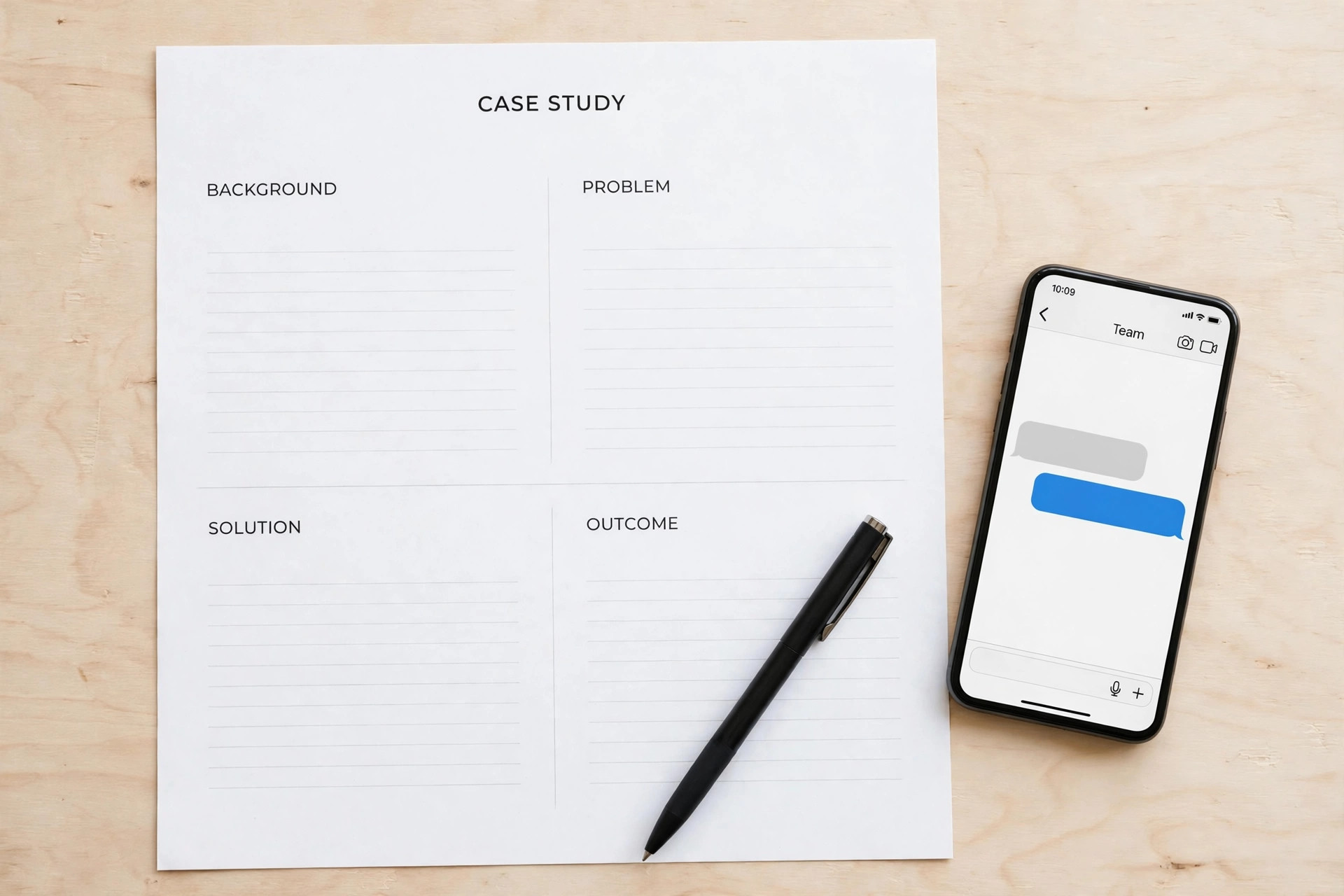
Step 1: Ask for Permission Before You Write a Word
Ask during offboarding, not six months later. The offboarding call is the easiest moment, because the client is happy, the result is fresh, and the ask is small. The ask has four parts, and it should fit in one short email if the call already happened.
- Name exactly what you want to share. Not "can I write about the project" but "can I share that cost per lead fell from $48 to $31 over three months, and that the landing page conversion rate went from 2.1 percent to 3.4 percent." A specific ask gets a specific yes. A vague ask gets a polite delay.
- Name where it will appear. Your website, your sales deck, and your social posts, for example. Clients say yes more easily when the audience is named, and they say no to the one channel they care about, which is a negotiation you can win, not a rejection.
- Offer anonymity as the default fallback. "If you would rather stay unnamed, I can write it as an unnamed ecom brand in your niche." Some clients will take the anonymous version, and an anonymous case study with real numbers still beats no case study at all.
- Ask for one quote, in their words. "In one sentence, what changed for you?" A client quote written by the client is worth more than three paragraphs written by you, and it is the part prospects actually read.
Get the yes in writing, even if the call was verbal. One line in an email: "Just confirming you are happy for me to share the numbers we discussed, on the site and in my sales deck." If the client says no, thank them, write the case study for your private file anyway, and use it as a sales-call story you tell verbally, without naming the client. A no to publishing is not a no to learning from the project.
Step 2: Pull the Numbers, Not the Adjectives
A case study needs three numbers at minimum: a before, an after, and a time frame. Everything else is supporting detail. Pull them within a week of the project ending, while you still have access and the dashboards still show the period clearly.
| Number | Where it lives | What to write |
|---|---|---|
| The before | The ad account, analytics, or CRM, from the month before you started | The baseline, with the date range attached |
| The after | The same source, from the last full month of the project | The result, with the same date range attached |
| The time frame | The project timeline | How long it took, in weeks or months, not "quickly" |
| The cost | The invoice or the ad spend | What the client spent, if they agreed to share it |
| The scope | The project folder | What you actually did, in one line per deliverable |
Write the numbers as a table before you write a single sentence. The table is the case study. The sentences around it are packaging. If a number has no source, leave it out. "Leads roughly doubled" is an adjective wearing a number costume, and a prospect who asks for the source will find you have none.
If the results are mixed, say so. A case study that names one honest miss, "the first landing page test failed, and the second one is the version that worked," reads as true, and a prospect trusts a true story more than a perfect one. A case study where everything beat target reads like a sales deck, and prospects can tell.
Step 3: Draft With AI, Then Rewrite the Judgment
Give the model the numbers table, the scope list, and the client quote, and ask for a one-page draft in four sections: the problem, what you did, the results, and the quote. The fixed structure matters, because it keeps every case study comparable, and a prospect who reads two of them can compare them in a minute.
The draft will be about 80 percent right. The 20 percent it gets wrong is the part that matters: it will smooth over the hard part, it will round a number up, and it will write a sentence you would never say. That is your job in the check step. Read the draft against the numbers table, line by line, and cut anything you cannot point to a source for. Then rewrite the judgment in your own words: why this approach, what you would do differently, what the client actually cared about. A model can structure the story. It cannot decide which part of the story is the point.
Keep it to one page. A case study that needs two pages is a project report, and project reports do not get read by prospects. One page, four sections, three numbers, one quote. If a detail does not fit, it belongs in the appendix of your private file, not in the published page.
Step 4: The Approval Loop, One Round, in Writing
Send the draft to the client within two weeks of the project ending, with a short email and a clear ask: approve, edit, or decline, by a date. One round of edits is the norm. More than two rounds means the draft was wrong, and you should rewrite it rather than iterate it to death.
What the client can change: any number, any claim, the quote, and their name. What the client cannot change is whether the result is real. If a client asks you to soften a number that is true, keep the true number or drop that line. A case study the client rewrote into something softer is a case study that no longer proves anything.
If the client does not reply in a week, send one follow-up, then stop. Silence is not approval, and an unapproved case study never gets published, however good it is. Log the draft as unapproved in your case study list, and move on. The follow-up is also useful signal: a client who will not approve a case study they agreed to in offboarding is telling you something about the relationship, and it is worth noting before the next project with them.
Step 5: Reuse It in Five Places
One case study, written once, should work in five places. Write the one-page version first, then cut it down for the rest, never the other way around.
- Your website. One page per case study, linked from your services page, with the numbers table at the top.
- Your sales deck. One slide, three numbers and the quote, shown when a prospect asks for proof in your niche.
- Your proposals. The relevant case study attached to the proposal, so the price arrives next to proof, not next to a promise.
- Your social posts. One post per case study, with the single most surprising number as the hook, linking back to the full page.
- Your follow-up emails. The case study link in the reply to a cold lead who asks "have you done this before," which is the question every cold lead is really asking.
Track all of it in one list: client, project, date, approved or not, where it is published, and the three numbers. The list is what stops you from writing the same case study twice, and it is what lets you answer "show me one in my niche" in thirty seconds, with a link, instead of promising to find one later.
What Breaks, and the Guardrail for Each
| Failure | Warning sign | Guardrail |
|---|---|---|
| Permission is never asked | Your best project cannot be named, and your best proof is unusable | Ask during offboarding, in writing, with the exact numbers named |
| The numbers are collected late | The before number is a guess, and the dashboard no longer shows the period | Collect within a week of the project ending, while access is live |
| A number has no source | A prospect asks for the source, and you have only your memory | The numbers table comes first, and a number without a source is left out |
| The draft sits unapproved | The case study lives in a folder for months, unpublished | Send it within two weeks, one follow-up, then log it and move on |
| The client rewrites it softer | The published version no longer proves anything | The client can change wording, not whether the result is real |
| One case study, one use | The page is published and never linked anywhere | Publish to the site, then cut it down for the deck, the proposal, and one post |
| Mixed results are hidden | Every case study is perfect, and prospects stop believing any of them | One honest miss in every case study, with what you changed because of it |
Rule: a finished project is not proof until the client has approved it in writing. Ask during offboarding, collect the numbers within a week, and publish within a month, or the evidence decays and the story is gone.
Lessons at the End
- Ask during offboarding, when the result is fresh. A specific ask with named numbers gets a specific yes. A vague ask gets a polite delay.
- The numbers table is the case study. Before, after, and a time frame, each with a source. Sentences are packaging.
- One page, four sections, three numbers, one quote. Anything longer is a project report, and prospects do not read project reports.
- AI drafts, you verify. Every number checked against its source, every claim cut that you cannot defend, and the judgment rewritten in your own words.
- Approval is one round, in writing. Silence is not approval, and an unapproved case study never gets published.
- Write once, use it five times. Website, sales deck, proposal, social post, and follow-up email. The list is what makes the reuse happen.
If you build only one thing from this post, build the offboarding ask and the numbers table: permission requested with the exact numbers named, in writing, during offboarding, and a before and after table collected within a week of the project ending. The ask takes five minutes. The table takes about thirty. Together they turn a finished project into the asset that wins the next one.